Category: ACT Chapter President

From the ACT Chapter President


Anzac Hall

The local architecture community was deeply shocked when news first broke of plans to demolish Anzac Hall. Surely, this was a mistake, as there had been limited consultation with the community and no consultation with the moral rights holders – the architects who designed the award-winning building – nor with the Australian Institute of Architects. Less than a week later, these reports were substantiated with the announcement of close to a half-billion-dollar redevelopment including demolition of Anzac Hall.

Further, it was revealed that work on these redevelopment plans had been secretly underway since 2015. Surely such a development within the public realm requires large scale community and stakeholder consultation? This process of conducting planning behind closed doors requires scrutiny. Perhaps this secrecy was connected to the potential for community backlash against the wasteful demolition of an award-winning building 17 years young which holds the memories of Australians who served our nation.

It should come as no surprise then that we at the Australian Institute of Architects have voiced such strong opposition to the plans that have finally been made public. While welcoming efforts to further honour the stories of Australia’s servicemen and women, we are at a loss as to why alternatives that allowed for the preservation of Anzac Hall as part of the redevelopment plan were not further explored. And alternatives there were.

At a recent meeting with Australian War Memorial Director, Dr Nelson, he confirmed that 18 different options had been put forward for consideration, 17 of which did not involve the demolition of Anzac Hall. This clearly begs the question as to why the one option that involved the demolition of the existing building was the one selected. We struggle to understand how this decision came about, the due process that should have been followed, and ultimately, who agreed to the proposed demolition.

The Australian War Memorial is a place of exceptional national significance. We accept that the institution needs to evolve over time and requires renewal to accommodate new functional requirements. However, needlessly obliterating Anzac Hall, a fit-for-purpose, award-winning, multi-million-dollar building is a colossal waste and mark of disrespect.

These sentiments have been echoed across the community.

Yet Dr Nelson told media he was ‘unapologetic’. ‘By the time it goes down,’ he said, ‘we will have had 19 wonderful years out of it’. This is spin of the highest order. Since when have public buildings become disposable? In building terms, Anzac Hall is in its infancy as our public architecture is designed and built to last 50 to 100 years or more.

Denton Corker Marshall (DCM) of Melbourne, one of Australia’s most innovative and respected architectural firms, designed Anzac Hall. Having previously designed the Memorial’s office building to the west of the main building, they knew intimately the challenges facing them when they were asked to design the Hall. Their design response was an exceptionally creative one, guided by the Memorial Director and staff, with a thorough and carefully considered conservation management plan, and respected conservation architects.

The completed hall with its great sweeping metal roof, so beautifully evoking the wings of a plane, sits deftly in front of, but not obscuring, the Memorial’s northern façade. A more sensitive design is hard to imagine. The interior is finely crafted, and the grand spatial qualities are seemingly limitless and large enough to suitably display the largest of Australia’s wartime heritage. So impressed was the respected jury of the Australian Institute of Architects’ National Architecture Awards that it awarded the building with its highest national honour, the Sir Zelman Cowen Award for Public Architecture in 2005.

Perhaps the real problem is that DCM executed their brief too well. As it stands, the building is (appropriately) understated, and contrasts with the grandiose vision portrayed in the recently unveiled plans. If grandeur and greater volume is what is desired, there are countless examples around Australia and the world of how expansion can be achieved in a way that preserves the integrity of existing site of the Australian War Memorial and its heritage components.

We therefore welcome open public conversation with the Australian War Memorial, the Government, government agencies, community, architects, planners and the media, with respect to the options for redevelopment of the Australian War Memorial that do not involve the unnecessary and wasteful demolition of Anzac Hall.

The Australian War Memorial must reflect the wishes of the community in whose heart it holds a special place. Our ‘Hands off Anzac Hall’ campaign has only just begun and we won’t give up until other voices in the debate over the Australian War Memorial’s future are heard. Visit our newly launched campaign website here.

Philip Leeson
ACT Chapter President
Australian Institute of Architects
From the ACT Chapter President

Nominations are being called for a number of positions on Chapter Council with the standard two year terms expiring soon with Alastair MacCallum who has been on Council for six years not seeking re-election.

Alastair has made an important contribution to the ACT Chapter and has been a strong voice for the profession, informed by his co-involvement in allied organisations including the Property Council of Australia and the Master Builders Association. This has given him a unique understanding of the development and construction industry that, like it or not, we are part of.

He was instrumental in instigating the Architectural Professional of the Year Award which he believes is a ‘worthwhile acknowledgement of those architects that contribute to the profession in ways other than or over and above design.’

Alastair is to be commended for his significant contribution to the ACT Chapter. We look forward to his on-going involvement in the Chapter’s activities and drawing on his professional expertise.

I hosted my first President’s luncheon, sponsored by Harvey Norman Commercial, in Mitchell a couple of weeks ago. Our special guest was Gordon Ramsay MLA, the newly appointed Minister for Building and Quality Improvement, amongst other portfolios.

In my short speech, I took the opportunity to acknowledge the Minister’s wide ranging roles within the Assembly and likened these to that of an architect who must have skills in all aspects of project delivery including design, planning rules, knowledge of materials and construction systems, financial skills and so on. The Minister spoke enthusiastically about the need to improve our building stock and acknowledged that our profession had a role in this endeavour.

In conversation, I raised with the Minister our concerns about ACT Procurement and the way projects are commissioned through building companies who in-turn engage consultant teams but only after architects are asked to submit concept designs under terms that are frankly, exploitative and demeaning as there is almost no prospect of the concept architect being engaged for ongoing services.

On this concerning note, I have just received an email from a member worried about a new school project being managed under an “interactive tender process” that is ultimately a design and construct project with all the flaws, pitfalls and unsustainable fees. I am hoping to convene a meeting among members interested in preparing a ministerial letter on this matter.

And breaking news. The Canberra Times reported that demolition of the national award winning Anzac Hall (2005) at the Australian War Memorial is being considered as part of a $500 million redevelopment. Rumours are rife and it is a matter that we are keeping a watching brief on. Moral rights holder, Denton Corker Marshall are outraged. Their design was subjected to the most critical analysis to ensure its impact on the Sodersten/Crust Memorial was minimal. Interestingly, on one of my occasional walk up Mt Ainslie, I noticed how poorly maintained the garden around the northern side of the Hall had become. Dry, dusty, barren – in stark contrast to the rest of the site. A portent of things to come perhaps?

Philip Leeson

October 2018

From the ACT Chapter President

There is much happening at the Chapter. I had the good fortune to hear 2018 Gold Medallist Alec Tzannes’ AM LFRAIA presentation recently and it was great to see so many attend.

Apart from the beauty and innovation of many of the projects he showed, Alec spoke about ‘architects as the trusted stewards of the built environment’ and that there was ‘good’ and ‘bad’ architecture.

With the community seeking their knowledge more and more online, it made me think about the role of architects as professionals. What is the future role of architects? How do we stay relevant as professionals in times where Google is king? And how do we as a profession publicly position ourselves as the trusted stewards of the built environment?

These are high order questions to which I don’t for one minute profess to have all the answers. Advocacy is one of the Institute’s key strategic platforms and it is through this public engagement that we can remind key decision-makers such as government ministers, government officials, and the community of the importance of architects in terms of their professional skills and expertise and their contribution to society at large.

Last week, Jess de Rome, Dean McPherson, Yuri Leong Maish and I presented on your behalf to the ACT Legislative Assembly Committee on Planning and Urban Renewal’s Inquiry into Engagement with Development Application Processes in the ACT.

While we are supportive of the current planning system in the ACT, there are many changes that can be made to improve the system so it is more efficient, red-tape is reduced, and it doesn’t take 3-4 months at a minimum for a DA to be processed.

Being part of this Committee’s Inquiry is one way that we can publicly demonstrate the professional expertise, knowledge, and public stewardship of architects in the ACT.

What are your thoughts on the future of the architecture profession? I would be interested in hearing your views at actpresident@architecture.com.au

Also, as a diary note, don’t miss hearing Dillon Kombumerri, Principal Architect at the Office of the Government Architect NSW this Wednesday as the third speaker in the Contemporary Australian Architect Speaker Series at the National Gallery. My thanks to Nathan Judd and Dominic Pelle for yet again coordinating a high calibre speaker series!

Philip Leeson
18 September 2018

From the ACT Chapter President – August 2018

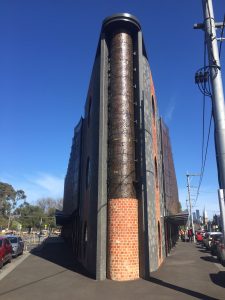
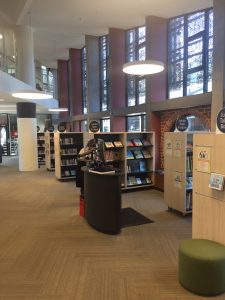
I attended the Melbourne Art Fair last week but took time out to look at the North Fitzroy Library by Group GSA. It was opened in April 2017 to much acclaim and the staff absolutely love it as does the community. It met with success at the 2018 Australian Institute of Architects Awards winning the Victorian Public Architecture Award and a Commendation for the Sustainability Award. At the time of my visit, the place was in full swing with all the study spaces and community rooms in use.
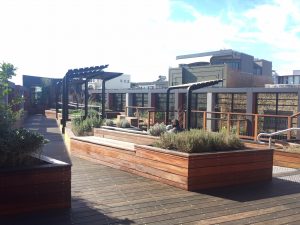
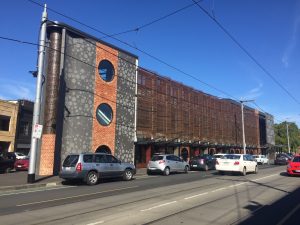
The building is located on a narrow, pointy wedge-shaped site bound by streets on the long north and south sides and a mixed-use building at the blunt western end. The long sides have been cleverly arranged to allow maximum natural light levels to permeate the whole of the interior. The pointy end is expressed as a semi-circular explanation mark formed with perforated metal and red brick. The return sides feature bold, texture finished precast concrete and brick punctuated with circular windows to a stairwell within. The long sides are predominantly glass protected externally by overlapping vertical, perforated screens and glass awnings that reflect the narrow facades of the 19th century shops on the opposite side of the strip. The really special thing about the place is its roof garden. This is no flat slab with a scatter of potted trees but a highly structured and beautifully detailed 3 dimensional adventure place spread over two levels offering places for quiet reading to children’s play areas.

This is one of those special projects that reflects the ideals of the profession – serving the community, making the world a better place through architecture in a sustainable and beautiful way.

Group GSA describe their project as follows “The North Fitzroy Library and Community Hub is a three storey, 2,040 sqm, 6 Star Greenstar facility incorporating a Library, Maternal Child Health Facility and a variety of Community focused facilities including a new home for the City of Yarra’s International House. Based on a neighbourhood house for seniors, the International House has become a cross generational meeting place for people of different cultures and ethnicities.

Designed with a strong focus on the user experience and flexibility, the floor plate displays a conscious distillation of cellular supporting spaces to the south and open flexible spaces to the north. The Library is distributed over two levels occupying the majority of the building’s wedge shaped floor plate. The first floor is divided between Maternal Child Health facilities, including two playgroup rooms and the Library reading area. Second floor features community facilities with large dividable spaces, commercial kitchen and shared community office. An extensive rooftop garden connects the northern portion of second and first floors via a cascading design of planters and informal seating. This Rooftop garden serves as an extension of both community and library spaces by providing a protected external garden space for interaction and study.”

Source: http://www.groupgsa.com/en/projects/north-fitzroy-library-community-hub/

Speaking of sustainability, advocacy and community good, the 2018 (just completed) Solar House Day initiative has been a wonderful success with the open house program being oversubscribed and the exhibition and Solar House Day lecture well attended with guest presentations by ACT Government Architect and Partner Townsend + Associates Architects, Catherine Townsend and Antonio Mozqueira, Senior Manager Climate Change Policy from the Environment Planning and Sustainable Development Directorate. The Speed Date an Architect was a hit. So, it’s a sincere thank you to Shannon Battisson, Peter Overton, Jenny Edwards, Ric Butt, Andrew Verri, Robbie Gibson, Ian Brumby, Paul Barnett, Maria Filardo and Institute staff Liz, Francesca and Colleen for arranging the bus tours, speakers, open houses, lecture, exhibition and most importantly sharing their passion for sustainable housing.

Philip Leeson
6 August 2018

North Fitzroy Library.
All images taken by Philip Leeson.
North Fitzroy Library
North Fitzroy Library – Rooftop Garden
North Fitzroy Library – Interior

From the ACT Chapter President July 2018

The biggest event in the ACT Chapter’s calendar is the awards night and the celebration of good architecture.

This year exceeded expectations by a series of happy circumstances, a measure of good luck and excellent management.

The continuing strength of the local economy generated a record number of nominations – 58 in total which, by default, boosted member attendance on the night. Nominations were received from large and small firms and as noted by the jury chair, projects ranged from a pop-up bay window to a pop-up urban village and everything in between. They represented works commissioned by the private sector, educational and public institutions, the CSIRO and the Federal Police.

The venue was an excellent space for the celebration but it was not the intended location. We were on track to celebrate the night in the foyer of the Museum of Australia but when it was discovered that the Museum had commissioned construction works, Leanne Hardwick and the chapter office team managed to snare Gandel Hall which was, unexpectedly, available. Gandel, with the arrangement of formal seating and open space, perfectly suited our needs and numbers and generated a lovely buzz on the night. The food was great and whoever chose the wines deserves high praise for quality and quantity.

This was my first big event as president of the chapter. The average person ranks the fear of public speaking right up there and I am in that camp. However, with terrific support from those around me and encouragement from Liz Lang our new ED, I got through it and received positive feedback along the way. So for all those intimidated by the prospect of taking on the President’s role in the future, it’s not that bad.

In my President’s address, I noted how few ACT Government sponsored projects had been nominated and speculated as to why this was so. I posed the question that if architects are required to attain tertiary qualifications, achieve AACA accreditation and maintain formal registration, why then are architects not an essential requirement in every government project. It seemed to strike a chord on the night and is an issue that I intend pursuing as the year progresses. However, before taking it further I would welcome input from members on how they have found the experience of working with ACT Government agencies. If you have something to say, please do let me know at act@architecture.com.au

Thinking back to the night, did I thank the Jury for their excellent work? It’s a tough but rewarding exercise and one that I would encourage members to consider. You’ll find a certain magic occurs when 6 people are thrown together for 10 or 12 hours a day for 4 or more days. Sincere thanks to the Jury and chair, Rob Henry.

The success of the night was largely due to the excellent management by the Chapter staff including Francesca Cooper, Mai Huynh, Yvette Potroz, Leanne Hardwicke (now with the National office) and our new ED, Liz Lang.

Finally, commiserations to those whose projects were not successful on the night and congratulations to those whose work was recognised for the special qualities that distinguished them ahead of all others. Congratulations also to the student awardees and those who received special recognition for their contribution to architecture including Shannon Battisson (Emerging Architect) Sander deVries (Professional of the year), Hal Guida (President’s Award) and Rachael Coghlan (Clem Cummings Award).

Philip Leeson
ACT Chapter President

From the ACT Chapter President


Leanne and I attended our regular meeting with Minister Mick Gentleman. Discussion points included:

  • the ACT Government’s Housing Choices Demonstration Project EOI aimed at finding organisations capable of delivering alternative housing solutions that address the missing middle. (Interestingly, at the above-mentioned industry heads meeting, there seemed to be a distinct lack of interest in this initiative).
  • The Collaboration Hub which I wrote at length about last month.
  • I raised the problems with the over-the-top TCCS regulations particularly in relation to multi-unit developments. The Minister reported that meetings are being held between the Planning and TCCS heads to find meaningful improvements.
  • The Minister referred to a recent tour of housing developments in the US and Europe. The take home message was that traditional parking requirements are being challenged with the advent of shared and autonomous vehicles.

The Chapter hosted representatives from ACT Procurement to update us on the Government’s latest procurement methods and contractual arrangements and I’m sad to say that the news is less than positive. Architects will be engaged to prepare initial concepts and may be asked to take the work to the next stage but more likely, it will be handed to a construction company to value manage the project with or without the original architect. Original architects will not be novated with the selection of the consultant teams entirely in the hands of the builder, regardless of the consultant’s particular skill or appropriateness. There may be a glimmer of hope, however, according to Richard Kirk, immediate past national president, with the recent release of the Sheargold Weir Report but more of this in future newsletters. https://industry.gov.au/industry/IndustrySectors/buildingandconstruction/Documents/Shergold-and-Weir-Report—BMF-Expert-Assessment.pdf

And so to the National Council Meeting and the National Conference on the Gold Coast. The Council meeting was the first for our new National President, Clare Cousins. It was held over a single day instead of the usual two as many of the Councillors and staff members had just returned from the Venice Biennale. Some of the more interesting matters discussed included:

  • Ongoing review of the Institute’s membership – cost, categories, A+ membership, academic and government members. The Institute represents 58% of all registered architects – if this can be increased to 70% we can more convincingly call ourselves the profession’s peak body.
  • Architecture Awards review – of particular interest to the ACT Chapter is the topic of state boundaries – do we continue to accept entries located in NSW and if so, what are the geographic boundaries?
  • Building contracts, banks and deposits. This is becoming an intractable problem with no easy fix unless the building industry as a whole can convince the banks that this is an issue ultimately hurting the consumer.
  • Digital transformation of the Institute. The whole of the Institute’s operation is going digital. The first step was the recent release of the updated Acumen web site.
    • Have you accessed Acumen and if so, how have you found it?
    • Is it comprehensive and easier to use as the previous version?
    • Do you use the EDG resource and if so, how much of it remains relevant given that many of the entries are quite old?
    • Do you think the EDG files should be a stand-alone resource or part of the Acumen site?

I would appreciate your feedback on these questions.

The National Conference was held over two days immediately after the National Council meeting and featured local and overseas speakers. I could only attend one day but it was a rewarding experience from a professional and social perspective. However, the presentations were rather too repetitive with lots of mega developments in Asia. There were no Q and A sessions either which was an unusual approach by the creative directors. For me, the highlights were presentations by Sue Dugdale working out of Alice Springs and Spanish architect Borja Ferrater.

Moshe Safdie was Thursday’s keynote speaker who I managed to “interview” that evening. I asked him about Habitat 67 and how his Master’s thesis project evolved into Montreal’s vast and iconic public housing project on the St Lawrence River. He explained it as a fairy tale. After graduation, and while working for Louis Kahn, he was asked to master plan the Montreal Expo. He agreed on the proviso that his “project” be built as part of Expo 67 and to his surprise, the organisers agreed saying that the work had to be done in his own time.

I asked Moshe what are the challenges facing architects nowadays?

He said, “…It is to break away from the mould and to deal with issues to which there is a fair amount of resistance. I find the biggest resistance particularly when it comes to the public realm is the inclination of developers to follow formula. I think public opinion is moving away from that formula. But it is a tough struggle to maintain some form of openness, some extravertedness and connectivity to make these spaces more public.”

During his keynote, Moshe gave an example of the ‘formula’ including skyscrapers on podiums enclosing privately controlled malls.

We have a new executive director, Liz Lang, replacing Leanne Hardwicke who has moved to the national office in charge of policy. I want to thank Leanne for her wonderful contribution to the ACT Chapter particularly and more broadly for her work at National level. Leanne has supported and guided me in my role as Chapter President for which I am indebted. Thank you Leanne.

Liz and I had a couple of long chats in Queensland and I am pleased to find that she is full of ideas for the Chapter and the presidency. To that end, it was Liz who lined-up Moshe Safdie for an interview with me which he kindly accepted.

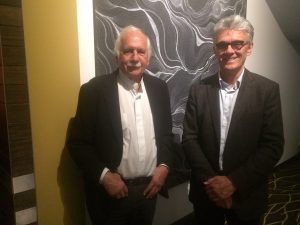
Image: Moshe Safdie and Philip Leeson

From the ACT Chapter President

If you’re like me, you take a quick look at the chapter newsletter then click to the next email, perhaps with the idea that you’ll get back to it later. Of course, we all know what happens.

As your new president though, I’m hoping that with this and future e-news you’ll be inspired to see what’s been happening, who’s doing what, and what events might be coming up.

The ACT Chapter recently welcomed the 2017 National Emerging Architect Prize recipient Anthony Balsamo at the ACT Chapter rooms and hosted a lively evening attended by almost 50, mostly young architects, graduates and students. The emerging architects committee ran an inspired night by arranging a support group of speakers before the main act. Aarthi Ayyar Biddle, Tim Dyer, Jeremy Mather, Jessica De Rome spoke to three themes Process, Perseverance and Procrastination with Jess de Rome adding a forth Purpose and an added dash of humour. There were plenty of refreshments at the event and I am told, the evening carried on well into the night at the Realm Hotel.

I spoke briefly at the event and encouraged the attendees that the future of the Institute is largely in their hands and encouraged them to get involved in the Chapter, to consider joining a committee and to tell us what they expect of the Institute. I welcomed suggestions for events they might like to see. A note of disappointment was the absence of older members – you missed a great show.

The ACT Government has embarked on its Housing Choices initiative with the catch phrase:
Canberra is changing – and there are many different way our housing needs can be met. What do we need to do?

There are two significant programs as part of the initiative including: 1) a call for expressions of interest from parties interested in building a demonstration housing development and 2) a consultative program involving a group of 35 randomly selected Canberra citizens called the Collaborative Hub conducted by interstate facilitators and EPSDD. The group will meet over 5 full day functions to hear a range of speakers from various professions such as architects, planners, demographers, and so on. They’ll have access to the 153 submissions received by ESDD on its Housing Choices prognostications and have opportunities to debate on what is needed to address the changes Canberra faces.

Ultimately, the Hub is to deliver a set of informed ideas that address the above catchphrase. The premise being, if everyday citizens are given complete access to all the information, and if they study that information in comprehensive detail, hear from subject-matter experts and are given sufficient time, they can reach a group consensus that most of the community can live with. It is envisaged that the outcome will inform changes to the Territory Plan and thus improve housing choices into the future.

By way of background. The ACT Government and EPSDD recognize that the Territory Plan inhibits innovation and is not addressing the need for housing types that fall between single detached housing and apartments. The term “missing middle” has been coined to describe housing types such as townhouses, group housing, community housing, manor housing (too English) particularly in established areas. The hope is that the demonstration housing project and the outcomes of the Collaborative Hub will show the broader community that we can do housing differently and more creatively.

The terms of the EOI for the demonstration village has disappointed some members who find that it’s targeting of those with land and the capacity to build, or those with the where-with-all to purchase land and develop is too restrictive. I took the opportunity to take this issue up with the planners and Leanne and I met with Joanne Mitchell and Bruce Fitzgerald from EPSDD in Ben Ponton’s absence. They explained that the Government wants to deliver – they want bricks and mortar on the ground (my words), not just another hypothetical. They explained that the respondents are expected to outline in their submissions how they challenge the Territory Plan, and indeed would welcome meaningful divergence to make the exercise worthwhile.

Notwithstanding my slight apprehension, the Government and its agencies are taking the matter seriously and should be praised for its efforts, and if Chief Planner Ben Ponton can get the territory plan “down to one page” he deserves a medal.

Philip Leeson,
ACT Chapter President
14 May 2018

From the ACT Chapter President – 4th April 2018

Let me introduce myself as the new president of the ACT Chapter of the Australian Institute of Architects. My name is Phil with an ip Leeson. I grew up in the country and moved to Canberra in 1981 to study architecture at the Canberra College of Advanced Education as a mature aged student. Peter Freeman, a Canberra based architect was on the thesis review panel and offered me a job on the day I presented my project. I worked with him for the next nine years until 1996 when I opened my own office. Here I am, 22 exciting years later with a staff of 11.

There’s been a long line of very capable architects who have taken on this role and whilst its not one I seriously contemplated or sought, I was happy to accept the nomination, albeit with some trepidation. I shouldn’t have worried as we have a terrific executive director and staff who are guiding me diligently through the system.

Our immediate past president Rob Henry was arguably one of the most enthusiastic and energetic presidents we’ve seen in recent times. This is no criticism of others who have taken on this task but is a heart felt acknowledgment of and thanks for his efforts from me and on behalf of the ACT Chapter and members. He achieved much in his two years at the helm and was ably assisted by a very capable Council and many dedicated volunteers.

I have taken on this role at the same time as the Institute adapts to a new model of leadership. Rather than an architect led Council, we have:

A Board of Directors comprising nationally-elected members and expert Independent Directors;

  • A member-elected National Council with representatives from each state and territory;
  • A revitalised executive team including a new CEO.

In addition, the Institute is now operating under a new governance structure that sets out the roles and responsibilities of the respective parties. And whilst many of you know this, there others who are only vaguely aware of what it all means. So, a brief summary – The Institute is a not-for-profit, public company limited by guarantee which is established to be, and to continue as, a charity. Its principle purpose is, as one would expect, to advance the cause of architecture through: A) Education, B) Culture and C) Social or public welfare. Interestingly, under B) you will find the following: by (i)  acquiring forming,  and  maintaining  Art  and  Scientific  Libraries  and Museums. I am keen to know more.

Furthermore there is a new Constitution; a new Chapter Council Charter; and new Rules for Chapter Committees and groups operating within Committees. For instance, the rules establish protocols for lobbying industry and government agencies.

If this were not enough for your new President to get his head around, there is the newly adopted “Strategy 2018 – 2020”. The Strategy is based on the three pillars of Education, Advocacy and Practice and sets out a clear vision and mission for the Institute. More of this in future columns.

I am looking forward to engaging with members, industry and the community and to meeting with members at the wide range of events on offer in the forthcoming the year. I would also like to attend committee meetings early in the year and as time allows to better understand the full range of activities of the Chapter.

Philip Leeson

From the ACT Chapter President – 19 February 2018

Hello. Thank you. And Goodbye.

In my last post as Chapter President, I would like to thank the numerous people that have assisted me in the role including councillors, committee chairs, regular volunteers, and of course our dedicated Chapter staff. It has been a real privilege to work with you to ensure this profession remains strong, active, relevant, and forward thinking.

I am delighted to see Philip Leeson taking over the position of Chapter President and I know that he will bring great wisdom and a measured viewpoint to the role. Philip will be officially starting his two-year term in March. Good luck PL!

I’d like to finish up my time with a snapshot of some achievements in 2017. As a small chapter, we should feel incredibly proud on what our volunteers manage to do for the profession.

1. Penelope Seidler noticed the prominence of women in the 2017 ACT Chapter Awards. The ACT Chapter continues to support equity and diversity and maintains high levels of female participation on Chapter Council and committees. The Diverse Equitable Employment Practices (DEEP) committee, is developing a terrific booklet to assist practices in achieving workplace equity and will be bringing together the ACT’s 20 largest practices in March to share positive success stories.

2. Housing Choices is finally on the ACT Government agenda, and again the ACT Chapter is leading the discussion. Following on from two years of discussions with Planning Minister Gentleman, we launched a website, Housing Choices: Canberra, to illustrate exemplar projects for developing the missing middle. NEAT Housing continues to be promoted and discussions have started for NEAT 2.0 as a response to the ACT Governments recent callout.

3. The ACT Chapter has grown their involvement in the Design Canberra Festival. For a small Chapter to manage some 15+ events in under three weeks illustrates that we are doing exceptionally well. Around 95,000 people attended events this year, so we are reaching people like never before, and getting the message across about the value of good design. Seeing 450+ people squeeze into a single house at once was rather comical, but also heart-warming.

4. The ACT Chapter joined forces with allied industry organisations to tackle procurement procedures for ACT Government projects. We hosted regular collaborative forums with Procurement and Capital Works, whom have started to implement changes. We will continue to push for improvements to ensure our members are being engaged ethically and remuneration reflects the services we provide.

Finally, thank you members for allowing a young lad to have a go. I hope I didn’t disappoint.
Over and out.

Rob Henry

ACT Chapter President’s Message

Design Canberra Festival

The Design Canberra Festival has been a terrific way to close out our events program for 2017. With the support of 15-20 members, we managed to run a variety of events that advocated for the use of architects. We had bus tours, open houses, open offices, heritage walking tours, drawing tutorials, design workshops, affordable housing seminars, choirs performing in architecture, and awards exhibitions. I hope you managed to get to some of the events during the three-week celebration of design. Thanks to everyone involved in the events, and to the many clients that opened their houses.


Housing Choice: Canberra

As you will be aware, the ACT Chapter has launched the Housing Choice: Canberra website that provides useful information on the direction we would like to see our city develop. We are calling for increased density and simplification of the Territory Plan to allow for innovation. Many thanks to Allan Spira for taking the lead role in the creation of this website, and to the numerous contributors of content. You can visit the website at: housingchoicecanberra.architecture.com.au


ACT Government Housing Choices Discussion Paper

Since the ACT Government launch of the Housing Choices Discussion Paper, we have been busy in the media showing our support and advocating for demonstration projects to be designed by architects. We have been on ABC radio, ABS local news, and written articles for The Canberra Times.

Please have your say on what the government should be doing by going to:

https://yoursay.act.gov.au/housing-choices


ACT Christmas Party

A reminder that the ACT Christmas party is on the 14th December 2017 at 5pm onwards. Please let us know if you are coming so that we can cater accordingly. This will be my last official event as Chapter President. How time flies.

RSVP here:  https://architectureact.wufoo.eu/forms/w1svnoub1ocmx1q/