
Category: ACT Chapter President

From the ACT Chapter President

Future of Government Contracts, Building Quality, Liveable Apartment design, Release of the Draft ACT Building Act.

13 July, 2015

“In Victoria, NSW and Queensland, governments not continuing contracts signed by their predecessors, hopefully, has not become a formula for governments leadership of infrastructure, building design and procurement.

In the ACT, the future of contracts over a substantial light-rail project are at issue.

The consequences of politicisation of many long-term projects is well documented:

  1. it costs the taxpayer when contracts are cancelled;
  2. it damages industry confidence at a time when it is needed most;
  3. it raises risk issues; and,
  4. it debilitates long-term strategic planning, the design and procurement process.

The key to retaining long-term focus is strategy. Strategies are defined in government policy. A constant reinforcement of progress towards a vision and the development of clear objectives broken down to three to four-year milestones to overcome political cycles are necessary tactics to achieve building projects.”[1]

If Canberra is to be competitive, creative and not to be held back by short-term decisions, if design of the built environment “is to be depoliticised, a broader understanding of the relationship between initial capital investment cost and the long term economic benefit is essential,”[2] equitable engagement contracts and, a strategic approach to design and construction procurement are required.

Measures to improve apartment design quality has been in discussion and action over the last 5 years. They include:

  • amendment to the ACT Building Act, in an attempt to improve quality by legislated penalty of building industry participants; or,
  • the adoption of informed government policies and guidelines, available at the projects outset, that illustrate to development proponents and the community high quality design outcomes.

The Institute is preparing a ‘Liveable Apartment Design Policy’ to advocate for a policy and guideline to improve apartment design quality. The policy and guideline will be informed by metric evidence of beneficial outcomes: cost – in construction; in energy use; in resale value; in user satisfaction; in design and built outcome quality.

The NSW Government has implemented their Department of Planning’s review of SEPP 65. In the new SEPP all the key positive elements have been retained and modifications are in the main, in line with the Institute’s recommendations. The key change is that the Residential Flat Design Code will now be a guideline, rather than a set of instructions. Some approval authorities were using the code metrics like a checklist, whereas they were only ever intended as quantified illustrations of the SEPP’s design principles.

To the amendment to the ACT Building Act, Chapter Council and the Practice Committee will welcome members comment. We understand its released is imminent.

[1] Consult Australia. Keith, Kevin. Published on Linked In, July 2015

[2] Op cit
From the ACT Chapter President – July 2015

Future of Government Contracts, Building Quality, Liveable Apartment design, Release of the Draft ACT Building Act.

“In Victoria, NSW and Queensland, governments not continuing contracts signed by their predecessors, hopefully, has not become a formula for governments leadership of infrastructure, building design and procurement.

In the ACT, the future of contracts over a substantial light-rail project are at issue.

The consequences of politicisation of many long-term projects is well documented:

  1. it costs the taxpayer when contracts are cancelled;
  2. it damages industry confidence at a time when it is needed most;
  3. it raises risk issues; and,
  4. it debilitates long-term strategic planning, the design and procurement process.

The key to retaining long-term focus is strategy. Strategies are defined in government policy. A constant reinforcement of progress towards a vision and the development of clear objectives broken down to three to four-year milestones to overcome political cycles are necessary tactics to achieve building projects.”[1]

If Canberra is to be competitive, creative and not to be held back by short-term decisions, if design of the built environment “is to be depoliticised, a broader understanding of the relationship between initial capital investment cost and the long term economic benefit is essential,”[2] equitable engagement contracts and, a strategic approach to design and construction procurement are required.

Measures to improve apartment design quality has been in discussion and action over the last 5 years. They include:

  • amendment to the ACT Building Act, in an attempt to improve quality by legislated penalty of building industry participants; or,
  • the adoption of informed government policies and guidelines, available at the projects outset, that illustrate to development proponents and the community high quality design outcomes.

The Institute is preparing a ‘Liveable Apartment Design Policy’ to advocate for a policy and guideline to improve apartment design quality. The policy and guideline will be informed by metric evidence of beneficial outcomes: cost – in construction; in energy use; in resale value; in user satisfaction; in design and built outcome quality.

The NSW Government has implemented their Department of Planning’s review of SEPP 65. In the new SEPP all the key positive elements have been retained and modifications are in the main, in line with the Institute’s recommendations. The key change is that the Residential Flat Design Code will now be a guideline, rather than a set of instructions. Some approval authorities were using the code metrics like a checklist, whereas they were only ever intended as quantified illustrations of the SEPP’s design principles.

To the amendment to the ACT Building Act, Chapter Council and the Practice Committee will welcome members comment. We understand its released is imminent.

[1] Consult Australia. Keith, Kevin. Published on Linked In, July 2015

[2] Op cit

ACT Chapter President


The Changing Role of ‘Risk’ in Architecture – 2015 National Architecture Conference inspired change to a sell-out audience.

International speaker from this year’s conference, Amanda Levete (UK) emphasised that Architects are risk takers as the doers of things, in a regulated, penalty infused economy. Our markets want the outcome of taking risks but, with guarantees and warrantees to protect against any chance of failure. Architects are capable of functional and technical inventiveness by drawing together knowledge from ordinary and extraordinary sources.

For architects to make architecture, a patron who accepts that managed risks in a project are noble, necessary is much needed. A patron who briefs for the needs of people in spaces configured for life … comfort to work, to rest and to recreate … with a good fit for the task, warm in winter, cool in summer, in touch with flora and fauna.

Another speaker, Jeremy Till (also from the UK) referred to Manfredo Tafuri’s description of architects “as gymnasts in the prison yard” while outlining possible responses to risk; pragmatic acceptance; sustained optimism; cynical pessimism or, radical engagement as Jeremy Mcleod demonstrated in ‘The Commons’ Nightingale development in Brunswick, Victoria by taking equity in new forms of building delivery.

In the re-development of Canberra the case to be made is that by its outstanding design, increased social and monetary profit is received because of the developments liveability, sustainability and desirability rather than simply on how high, how much area, how much money is returned to the budget.


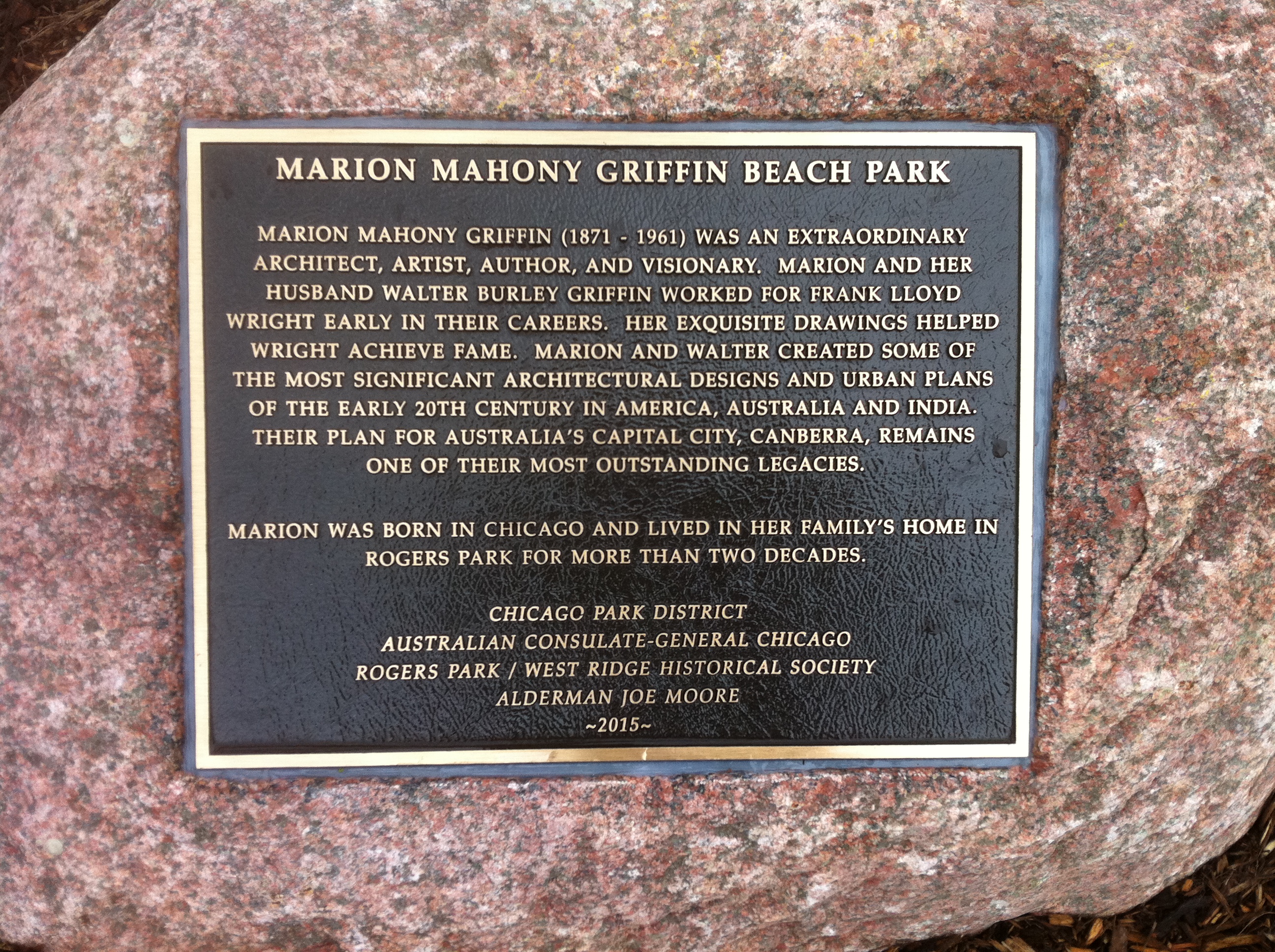
Canberra’s co-designer has been honoured in her native Chicago.

On 9 May 2015, Marion Mahony Griffin, co-designer of Canberra with her husband Walter Burley Griffin in 1912, was honoured by the naming of a park in the suburb where she lived for the last stage of her life.  The Rogers Park/West Ridge Historical Society in northern lakeside Chicago gave enthusiastic support for the naming of Marion Mahony Griffin Beach and Park, writing:

“(This) will keep before beachgoers the model of a vastly talented woman who not only broke down barriers by entering a field still today dominated by men but became one of the foremost innovators of the twentieth century.  Furthermore, she will be celebrated as an artist in a neighbourhood that has become a home to many contemporary artists.”

Photo: Christopher Vernon (UWA)

Marion Mahony Griffin

More details:

http://rpwrhs.org/2014/12/28/renaming-jarvis-beach-and-park-to-marion-mahony-griffin-beach-and-park/

http://www.griffinsociety.org/home1.html

For too long, women practitioners have lacked a visible presence in our profession (if we need reminding, just take a look at Wikipedia’s list of notable architects), despite their significant and worthy contribution to architecture.

The reasons for this are many, but the actions of Parlour Inc., the National Committee for Gender Equity of the Institute, and the work of many passionate and committed individuals, this is changing.  By bringing visibility to our women practitioners and formally acknowledging their accomplishments, we are supporting women’s engagement with the profession.  This is good for the profession, but even better for our built environment.


From the Chapter President


The Institute members and staff welcome Melanie Croaker as ACT Chapter Manager. Melanie is well known and supported. Her passion for architecture, knowledge and strategic planning skills will promote architecture through events, support member services, continuing professional development and representation in government and industry forums.

The return of the National office to 2a Mugga Way and colocation with the ACT Chapter will enable us to undertake ‘high hitting’ achievements with efficiencies. The incoming Chapter Council looks forward to the Institute being a collegiate ‘go to place’, openly communicating with members and institutions with participation from students, graduates, registered architects from all stages and experiences of their professional careers.

The ‘2010 Building Quality in the ACT report to the ACT Governments and the subsequent review of the ACT Building Act 2004 is a response to the costs to the community of buildings and building services that arise when basic standards and protections are not achieved. The scope of the review includes all aspects of building regulation, including:

Pre-construction: Design compliance, contracts, obligations of developers, approvals, exemptions, practitioner licensing;

Construction process: Compliance with plans, stage inspections, on-site supervision, amendments;

Post construction: Final inspections, certificates of occupancy; and,

In general: The scope of the Act, administration and enforcement (public and private), insurance, skills, training, accountability of practitioners, owners rights and obligations, consumer protection, complaints and dispute resolution, funding and governance, interactions with related legislation, offences and penalties! For more information, refer to the: Overview of the Review of the ACT Building Act 2004.

When approved by the Minister for Planning a discussion paper based on the findings of the review will be released in early 2015 (anticipated to be April).

The review of the Construction Occupations (Licensing) Act 2004 will be released in late 2015 (anticipated to be December).

Members are encouraged to contribute to the professions response to this review by providing comment in writing to the Chapter office, committees and Council.

The implications of these reviews are significant, for the professions future terms of engagement, scope of service, time commitment, fee/remuneration, responsibilities, liabilities and insurability.

To realise a rich and diverse built environment that the community wants, celebrates and comfortably occupies and loves, a clear brief and fulsome engagement is required by the client, architect and constructor.

From the Chapter President

3 Feb

Elections
As many of you would be aware my presidential term comes to a close in the near future and for the first time in many years there will be more than one candidate and consequently an election. Combine this with the with the nomination of more people standing for Chapter Council than there are places available it suggests there is an increasing vitality and desire to engage with the profession from within the membership … Long may it continue.

Media Canberra Times articles – The ACT Government considering relaxing planning laws that prevent people from building houses that cast shadows over neighbour’s yards.
A great proportion of the effort to highlight the nonsense in the regulations has come from the insights and hard work done by our members over a period of time and was triggered to a certain extent by three articles in the Canberra Times on the same day (including being on the front page and focusing particularly on architects comments). Please follow the links to read.

http://www.canberratimes.com.au/act-news/overshadowing-planning-law-likely-to-be-rolled-back-20140128-31l79.html
http://canberratimes.domain.com.au/real-estate-news/act-planning-law-changes-key-to-sustainable-and-energyefficient-living-20140111-30nfc.html
http://www.canberratimes.com.au/comment/ct-letters/division-over-canberra-subdivision-designs-20140118-311ly.html
http://www.canberratimes.com.au/act-news/act-laws-put-passive-solar-homes-in-the-shade-20140111-30nuc.html
http://www.canberratimes.com.au/comment/ct-editorial/were-facing-the-wrong-way-on-smart-housing-20140111-30nr9.html 

Advocacy and Policy
The ACT Government has invited the architectural community to comment on the Regulation of the Design practitioners in the ACT. The ACT Chapter has formed a Task group they include; David Clarke (Chair) supported by Tony Trobe, Catherine Townsend, Ben Walker, Murray Coleman and Sheila Hughes with policy support from the National office Richard Barton and Kylie Ruth. A meeting was held last week and it was agreed to have a representation at the Government consultation sessions and to prepare a collaborative response to Government in the form of a submission.

Additionally, we have been invited to report on the issues surrounding the current operations of the ACT Registration Board. Catherine Townsend and Alan Morschel in their capacity as ACT Registration Board members are preparing this report.

Both submissions are due on the 28 Feb and if any member would like to contribute to the process please contact the Chapter Manager.

Tony Trobe
ACT Chapter President

From the Chapter President

28 Jan

Typology display village
In response to the frustration with the limitations imposed by some current planning controls in the ACT, and in an effort to explore housing typologies which will be more in tune with the aspirations of the ACT community, the Chapter has been promoting a concept to design and construct a demonstration project containing several alternative house/unit types not commonly seen in Canberra.

The proposal has received significant support from within Government in the form of LDA, ACTPLA …and also including Minister Corbell himself. The proposal is to design and construct up to (say) 12 to 15 homes, across a variety of types, preferably in a central accessible location to meet the following criteria;

•    To explore suitable new housing types for infill sites,
•    To do so outside of the current regulatory control environment, so as to test and explore the validity of the new typologies.
•    To educate and broaden the Canberra community’s perception of what a house or home might be.
•    To explore avenues for alternative approaches to more affordable housing.
•    To be the basis for consideration and implementation of more flexible planning controls.
•    To promote the value of architecture and design to the community

It is intended to hold some form of design competition to design, build and market contemporary homes that respond to the needs of all levels within the emerging Canberra market without the normal planning controls inhibiting innovation. Part of the competition criteria will be that there will be mandatory involvement of a registered architect.

This will be a rare chance to demonstrate what architects believe the markets are crying out for, at a premium infill site, without being hamstrung by the current planning controls. It time for us to be an agent for change, to push the envelope!

Light rail competition
Some members who may have missed the members Christmas party would also have missed an exciting initiative. The big announcement of the night was the official launch of a design ideas competition for a Canberra Light Rail station with a trip for two to the Venice Biennale among the great prizes up for offer.  The competition is for ACT Chapter members exclusively including architects, graduate architects and students of architecture.

For more information please visit www.architecture.com.au/light-rail-station-competition

Elections
As many of you would be aware my presidential term comes to a close in the near future and for the first time in many years there will be more than one candidate and consequently an election. Combine this with the with the nomination of more people standing for Chapter Council than there are places available it suggests there is an increasing vitality and desire to engage with the profession from within the membership … Long may it continue.


Tony Trobe
ACT Chapter President


From the Chapter President

I recently attended a Pecha Kucha night in Braddon run by Tate Waddington Architects. The vibrancy of this evening indicated to me that there is a potent interest in a broad range of design matters across the whole spectrum of disciplines in the capital. Although this event was well supported by architects it was not however an Institute organised event.

The event itself seemed to be a great networking opportunity, particularly for young architects and students and it would be a great coup for the chapter if some of this manifest energy could emanate from within the Institute rather than perhaps being seen as a counterpoint to it. The Institute should never be seen as a club for employers but as a touchstone for all those who have a connection to the profession.

With this in mind it should be noted that within the next few months there will be an opportunity for the membership to elect new chapter Councillors and it would be of great benefit to the Institute if these spots were competed for by energetic and passionate architects. To all to see some of the buzz and energy that was evident at the Pecha Kucha night overlaid onto the core activities of the chapter would be a rising tide lifting all boats. I would encourage some of the younger members of the Institute who in the past may not have considered putting their hands up for an elected position to seriously consider it this time around.

The position of the chapter president will also become vacant soon. There is no mandate that says the candidate should come from within the current round of chapter Council members. I would encourage all members to approach the chapter with any suitable suggestions into whose hands this important role could possibly be placed.


Tony.

Tony Trobe, ACT Chapter President


From the Chapter President

Last week Glen Murcutt attended a president’s lunch at the chapter and in the evening went on to feature in a ‘Michael Parkinson’ style interview with our own Annabelle Pegrum as part of the contemporary speaker series at the National Gallery. This was a sell-out. Given this success it makes it clear that given the right exposure the public have a significant appetite for architecture and design. We, as a profession just need to continue to provide it.

We seem to be claiming a toehold within key media outlets including: the Canberra Times Relax magazine on Sundays, a weekly president’s column on Saturdays and biweekly ABC interviews with Alex Sloan on 666; it would be great to be able to build on these.

To keep the momentum with these initiatives however we do need the active involvement of chapter members so I would greatly encourage all members to think about potentially becoming involved. The Canberra Times Relax represents incredible value for the promotion of practices; particularly for anybody working in the domestic sphere. It is surprising to me that we struggle to find suitable candidates to participate.

I personally am always searching for contributors to the weekly column in the paper; all that is required here is that for ‘guest of the week’ to come up with 450 words on a topic that they are passionate about in ‘question-and-answer’ format. This is a very simple process and an easy vehicle pass comment on a wide variety of design issues. It is also very visible platform for us as a profession to keep architecture at the vanguard of the news cycle.

This is a plea for more members to step forward.

Tony Trobe
ACT Chapter Manager