Category: National news

Jury announces shortlist for the 2014 National Architecture Awards

The Australian Institute of Architects’ National Jury has revealed their shortlist for the 2014 National Architecture Awards with winners to be announced on 6 November in Darwin.

61 projects were selected by the jury to progress to the final stage of judging, with many projects in the running across multiple categories. See accompanying release for the full list of shortlisted projects.

153 projects were eligible for consideration by the National Jury after receiving awards at their respective chapter award ceremonies held around the country in June and July. Every state and territory is represented in the shortlist in addition to five international projects by Australian architects.

The Jury Chair, Immediate Past President, Paul Berkemeier, was impressed with the collaborative and generous nature of many of the projects entered in the awards program.

‘As a jury and as members of the profession, we were inspired by the number of projects that had informed clients working closely with the architects to achieve better outcomes. In many instances, this relationship allowed the project to go well and truly above and beyond the original brief,’ Mr Berkemeier said.

‘The process of selecting the shortlist was a challenging one, which the jury made with careful deliberation. The projects that were eligible were of outstanding quality and we believe the resulting shortlist represents the best of the best.

‘All eligible and shortlisted entrants should be very proud of the work they have achieved; their projects are invaluable in promoting the exceptional work of Australian architects both here and overseas.’

Paul Berkemeier was joined on the jury by Clare Cousins, Justin Hill, Virginia Kerridge and Lindy Johnson. The jury visited all shortlisted projects, except international works, during a two week tour.

This year, a total of 821 entries was received for the awards program across the 13 national categories.

The National Architecture Awards will be held at the Darwin Convention Centre on Thursday 6 November.

2014 National Architecture Awards – Jury Shortlist

Commercial Architecture (7)

8 Chifley Square – Lippmann Partnership/Rogers Stirk Harbour & Partners (NSW)
55 Elizabeth Street – BVN Donovan Hill (Qld)
Bread in Common – spaceagency (WA)
Lune de Sang – Sheds – CHROFI (NSW)
Prahran Hotel – Techne Architects (Vic)
Toyota WA Head Office – Roxby Architects (WA)
White Bay Cruise Terminal – Johnson Pilton Walker (NSW)

Enduring Architecture (4)

Apostolic Nunciature – Enrico Taglietti (ACT)
CB Alexander College, Tocal – Ian McKay and Phillip Cox, Architects in Association (NSW)
McIntyre House – Peter McIntyre (Vic)
Troppoville – Troppo Architects (NT)

Heritage (4)

Bread in Common – spaceagency (WA)
Brisbane City Hall Restoration Project – Tanner Kibble Denton Architects and GHD Architects in Association (Qld)
Eternity Playhouse – Tonkin Zulaikha Greer Architects (NSW)
Former Police Station, 127-129 George Street, The Rocks – Welsh + Major Architects with Sydney Harbour Foreshore Authority (NSW)

Interior Architecture (8)

Australian Taxation Office Elizabeth Street – HASSELL (Qld)
Bread in Common – spaceagency (WA)
Garangula Gallery – Fender Katsalidis Mirams Architects (NSW)
Hotel Hotel – March Studio (ACT)
South Australian Health and Medical Research Institute – Woods Bagot (SA)
Sustainable Industries Education Centre – MPH Architects + Architectus in association (SA)
UQ Advanced Engineering Building – Richard Kirk Architect HASSELL Joint Venture (Qld)
UTAS Institute for Marine & Antarctic Studies – John Wardle Architects + Terroir, in Association (Tas)

International Architecture (5)

ASB North Wharf – BVN Donovan Hill (New Zealand)
PARKROYAL on Pickering, Singapore – WOHA (Singapore)
Shelter@Rainforest – Marra + Yeh Architects (East Malaysia)
Stonehenge Exhibition + Visitor Centre – Denton Corker Marshall (United Kingdom)
The Sukhothai Residences – Kerry Hill Architects (Thailand)

Public Architecture (11)

Abedian School of Architecture – CRAB Studio (Qld)
Australian PlantBank – BVN Donovan Hill (NSW)
Dallas Brooks Community Primary School – McBride Charles Ryan (Vic)
Dandenong Mental Health Facility – Bates Smart Whitefield McQueen Irwin Alsop Joint Venture (Vic)
North Bondi Surf Life Saving Club – Durbach Block Jaggers in association with Peter Colquhoun (NSW)
OLMC Parramatta Janet Woods Building – Tzannes Associates (NSW)
Prince Alfred Park + Pool Upgrade – Neeson Murcutt Architects in association with City of Sydney (NSW)
South Australian Health and Medical Research Institute – Woods Bagot (SA)
UQ Advanced Engineering Building – Richard Kirk Architect HASSELL Joint Venture (Qld)
UQ Dayboro Vet – Owen and Vokes and Peters (Qld)
UTAS Institute for Marine & Antarctic Studies – John Wardle Architects + Terroir, in Association (Tas)

Residential Architecture – Houses (Alterations and Additions) (7)

Bellevue Terrace Alterations + Additions – Philip Stejskal Architecture (WA)
Highgate Hill House – Twofold Studio & Cox Rayner Architects (Qld)
Lune de Sang – Stone House – CHROFI (NSW)
South Yarra Warehouse – NMBW Architecture Studio (Vic)
Strohmayr House – Troppo Architects (NT)
Tamarama Semi-D – David Langston-Jones (NSW)
West End Tower – Owen and Vokes and Peters (Qld)

Residential Architecture – Houses (New) (6)

Griffith House – Popov Bass Architects (NSW)
House at Hanging Rock – Kerstin Thompson Architects (Vic)
Hover House – Bower Architecture (Vic)
K House – Chenchow Little (NSW)
Oxlade Drive House – James Russell Architect (Qld)
Southern Outlet House – Philip M Dingemanse (Tas)

Residential Architecture – Multiple Housing (4)

Gantry – Bates Smart (NSW)
The Commons – Breathe Architecture (Vic)
University Hall – HASSELL (WA)
UNSW Kensington Colleges – Bates Smart (NSW)

Small Project Architecture (6)

Balmain Apartment – Durbach Block Jaggers (NSW)
Baroona Road Mixed Use Redevelopment – Shane Thompson Architects (Qld)
Bicheno Surf Life Saving Club + Boathouse – Birelli art + design + architecture (Tas)
Geelong Ring Road Rest Areas – BKK Architects (Vic)
Kew Studio – Sean Godsell Architects (Vic)
Studio 217 – Amalie Wright & Richard Buchanan (Qld)

Sustainable Architecture (7)

Australian PlantBank – BVN Donovan Hill (NSW)
South Australian Health and Medical Research Institute – Woods Bagot (SA)
The Commons – Breathe Architecture (Vic)
The Wayside Chapel – environa studio (NSW)
UQ Advanced Engineering Building – Richard Kirk Architect HASSELL Joint Venture (Qld)
UTAS Institute for Marine & Antarctic Studies – John Wardle Architects + Terroir, in Association (Tas)
White Bay Cruise Terminal – Johnson Pilton Walker (NSW)

Urban Design (5)

Box Hill Gardens Multipurpose Area – NMBW Architecture Studio + ASPECT Studios (Vic)
GASP! Stage 02 – Room 11 (Tas)
National Arboretum Canberra – Tonkin Zulaikha Greer and Taylor Cullity Lethlean (ACT)
Prince Alfred Park + Pool Upgrade – Neeson Murcutt Architects in association with City of Sydney (NSW)
UTAS Institute for Marine & Antarctic Studies – John Wardle Architects + Terroir, in Association (Tas)

COLORBOND® Award for Steel Architecture (5)

Kew Studio – Sean Godsell Architects (Vic)
South Australian Health and Medical Research Institute – Woods Bagot (SA)
Troppoville – Troppo Architects (NT)
UTAS Institute for Marine & Antarctic Studies – John Wardle Architects + Terroir, in Association (Tas)
Whitebay Cruise Terminal – Johnson Pilton Walker (NSW)

View the National Architecture Awards Image Gallery here.

Competition Policy Reference Group

Interested in being part of a national Competition Policy Reference Group?

The Competition Policy Review Task Group was established by National Council in March 2014 to review and revise the Institute’s Architectural Competitions Policy, and the Competitions Guidelines that provide the basis for Institute endorsement of architectural competitions.

As part of this process, and to adhere to the Institute’s Consultation Policy, the task group is seeking to consult with members and others with knowledge or experience in the conduct of architectural competitions.

Timings

It is envisaged that the Task Group will deliver:

–  An initial draft policy document to National Council in December 2014

– A developed version of the policy and a first draft set of Architectural Competition Guidelines to National Council in March 2015

– A final draft policy and Guidelines to be submitted to National Council in July 2015.

During this time, the Competition Policy Reference Group will be required to review draft documents and take part in a number of teleconferences, the first of which is scheduled to take place on Thursday 16 October 2014 at 2pm DST.

How to apply

Expressions of interests are now open.  If you are interested, simply:

1. Forward a one page cover letter detailing why you would be a valuable member of the Competition Policy Reference Group and what knowledge or experience you would bring.

2. Attach a one page summary CV.

3. Submit your application by email to daniela.crawley@architecture.com.au

Closing date for the EOI is Fri 26 September 2014.

Members honoured at UIA Durban

The UIA Work Program, Architecture for All created, for the occasion of the UIA 25th Congress in Durban, an international award to recognise constructions uniting architectural quality and accessibility and whose designers have provided all users, without discrimination, quality of life and function. The attractive, inclusive and sustainable buildings should have been completed on 1 January 2009. Part of the prize also recognizes architects whose research has contributed to promote and advance the theory and practice of universal design.

Congratulations to Conrad Gargett Riddel Ancher Mortlock Woolley Architects and Allen Kong Architect, both practices received Honorable Mentions for their projects Old Government House, Brisbane and Potter Street Redevelopment, Dandenong respectively.


AWARDED REALISATIONS

  • Nikiforidis-Cuomo Architects for the New Waterfront at Thessaloniki, Greece
  • Ingarden and Ewy Architects for the Malopolska Garden of Arts, Krakow, Poland
  • Alberto Ferrer and Teresa Hermida from SCF Architects for the Salvation Army Community Center in Puerto Rico

HONOURABLE MENTIONS

  • Jim Clemes Architects for the Belval Train Station, Luxembourg
  • Force4 Architects with Cubo Architects for the Vandhalla Water Training & Rehabilitation Center, Denmark
  • Carrascal-Fernandez de la Puente Architects for the Palace of Justice, Burgos, Spain
  • Daflos & Panagouli Architects for the Melissia Social Centre, Athens, Greece
  • Allen Kong Architect for the Potter Street Redevelopment, Dandenong, Australia
  • Conrad Gargett Riddel Ancher Mortlock Woolley Architects for the Old Government House, Brisbane, Australia
  • Ronald Lu & Partners Architects for the Revitalization of Pak Tsz Lane Park, Hong Kong
  • Samoo Architects & Engineers for the Buk Seoul Museum of Art, Seoul, Korea
  • Naniopoulos, Kalliagra, Papanikolaou Architect for the Prospelasis Project, Thessaloniki, Greece

AWARDED RESEARCH

  • Magda Mostafa, for her research ‘Autism ASPECTSS Design Index’

HONOURABLE MENTIONS

  • Andreas Lauesen from Force 4 Architects for his project Accessible Everyday for Everybody
  • Francisco Javier García-Mila Lloveras,Verônica Camisão and Eduardo Álvarez for their project Operational Guidelines on Accessibility in Urban Development Projects


Apartment Design Standards Matter

27 July 2014

Following the leak this week of confidential draft apartment design standards from the Office of the Victorian Government Architect (OVGA) there has been much discussion about the future of apartment design in Melbourne and other Australian cities. In particular, some developers have come out against imposing design standards saying they will impact on housing affordability. They say that design standards should be dictated by market forces. News articles have highlighted the high demand for inner city dwellings and cite examples of high prices being paid to rent sub-standard dwellings in Australia and abroad (including Korean students paying $160/week to live in shipping containers in Sydney).

In reality, developers are motivated by profit not affordability. They seek to build as cheaply as possible and to sell for as much as possible. Fair enough. That is why regulation of minimum standards is essential to protect the interests of occupants now and into the future, long after the developers have taken their profits and moved on. The current high demand for dwellings skews market forces in favour of developers seeking quick profits, so controls are required now more than ever to ensure we do not end up with a poor housing legacy.

The Australian Institute of Architects (Institute) has not seen the OVGA draft standards document so are not privy to its details. We are aware that the proposed standards are based on NSW Residential Flat Code which form part of their SEPP65 framework. The Institute supports the SEPP65 model and calls for similar planning legislation to be implemented in all jurisdictions.

It is important to note that SEPP65 contains not only design guidelines, but also the requirement to use registered architects to design multi-storey apartment buildings; the requirement for design review panels and the requirement for ongoing checking that the approved design intent is being maintained through project procurement and construction. The current review of SEPP65 confirms that the legislative package has resulted in improved living standards in NSW and has received broad support from the industry sector and local authorities.

The Institute supports the implementation of design guidelines that will result in improved living standards. Housing affordability can be achieved through innovative design by skilled architects. Affordability includes the cost of ongoing energy consumption and building maintenance (costs that are not borne by the developer), all of which can be reduced through quality design. By adopting SEPP65 style framework, performance based design quality guidelines can be applied in a flexible way to allow innovative design solutions which lead to improved affordability, housing diversity, and improved living standards – now and into the future.

David Karotkin FRAIA
National President
Australian Institute of Architects

SONA SuperStudio: Seeking Tutors

SuperStudio Victoria is looking for interested practicing architects and recent graduates to donate their time to tutor students. It will be held at Deakin University, Waterfront Campus in Geelong, kicking off from 7pm Friday the 1st of August, and finishing at 7pm Saturday the 2nd of August. There would be roughly three different shifts to choose from, Friday evening, Saturday morning or Saturday afternoon, with each running for 2-3 hours. During your shift you will be engaging with students and helping them form ideas, as well as being provided with food. There will also be drinks during the presentation and awards on the Saturday evening.

If you would like more information, please visit click here, or if you would like to express your interest, please send an email to deakin@sona.com.au.


Approx. shift times: 

Shift 1 | Friday evening | from about 8pm to 10pm, this shift will help students with the early stages of the project. I will encourage however if you want this shift, why not come for the “Reading of the Brief” at 7pm?

Shift 2 | Saturday mid-morning | Helping the students from around 10am to 12 or 1pm, and this shift can also stick around for lunch.

Shift 3 | Saturday afternoon | From around 3pm to 5pm, this shift will be involved with more final designs/ideas, with encouragement to perhaps stick around for the presentations and awards.
If you are unable to tutor but still wish to see what SuperStudio is about, we invite you to the presentations of the projects and the awards on Saturday, 2nd of August, starting at 7pm, at Deakin University, Waterfront Campus in Geelong. There will be food and drinks available to guests, a great opportunity to see what students are producing and where the future of architecture is heading. If you would like to come along the Saturday evening, please email us at deakin@sona.com.au so we can get an idea of numbers for catering and drinks.


SS-eComm-600


Important changes at the Institute

The Institute has embarked on a program of significant change in the way our staffing and resources are organised. These changes are designed to create a more efficient organisation through greater strategic alignment and a more direct focus on members and other stakeholders. As a result, we are pleased to announce the appointment of three new General Managers:

Jamie Penrose has been appointed to the new position of General Manager Member Engagement. Jamie has recently come from a similar role as the Director, Member Services for the Pharmaceutical Society of Australia, was previously the General Manager Marketing at Engineers Australia, and has also held leadership roles with Animal Health Australia and the Sydney Convention and Exhibition Centre. Jamie commenced his new position on 26 May 2014. Jamie is based at National Office, Canberra.

Cameron Frazer, previously the Institute’s General Manager of Archicentre, has accepted the new position of General Manager Commercial and Community, and commenced his role in early May. Cameron will continue to be based in Melbourne.

Vanessa Goss has been appointed General Manager Shared Services. Over the past decade or more, Vanessa has been employed in a range of change-focused and corporate services roles as General Manager, Chief Executive Officer and Company Secretary. She has worked for a number of non-profit and commercial organisations spanning rural research and development, advertising, communications and legal services. Vanessa commences her new role today and is based at National Office, Canberra.

These new appointments have created important changes for the previous senior management team:

Greg Hughes will remain with the Institute in a new, senior role within the Shared Services division.  Greg will take up the newly created role of National Manager, People Places and Culture.

Carmel McCormack has left the Institute, as her role of General Manager Membership and Programs became redundant as part of the re-organisation process.

Cameron Frazer, previous General Manager Archicentre, has been successful in securing the new role of General Manager Commercial and Community, as detailed above.

Peter Macie, currently General Manager Finance, has decided to take the opportunity presented by the re-organisation and will leave the Institute at the end of July.

During this period of change, the Institute is very effectively continuing to deliver its full range of programs, services and events at the very high standards to which members are accustomed.

Institute welcomes David Karotkin as 75th National President

David Karotkin has become the 75th National President of the Australian Institute of Architects at the Annual General Meeting held in Melbourne on 28 May.

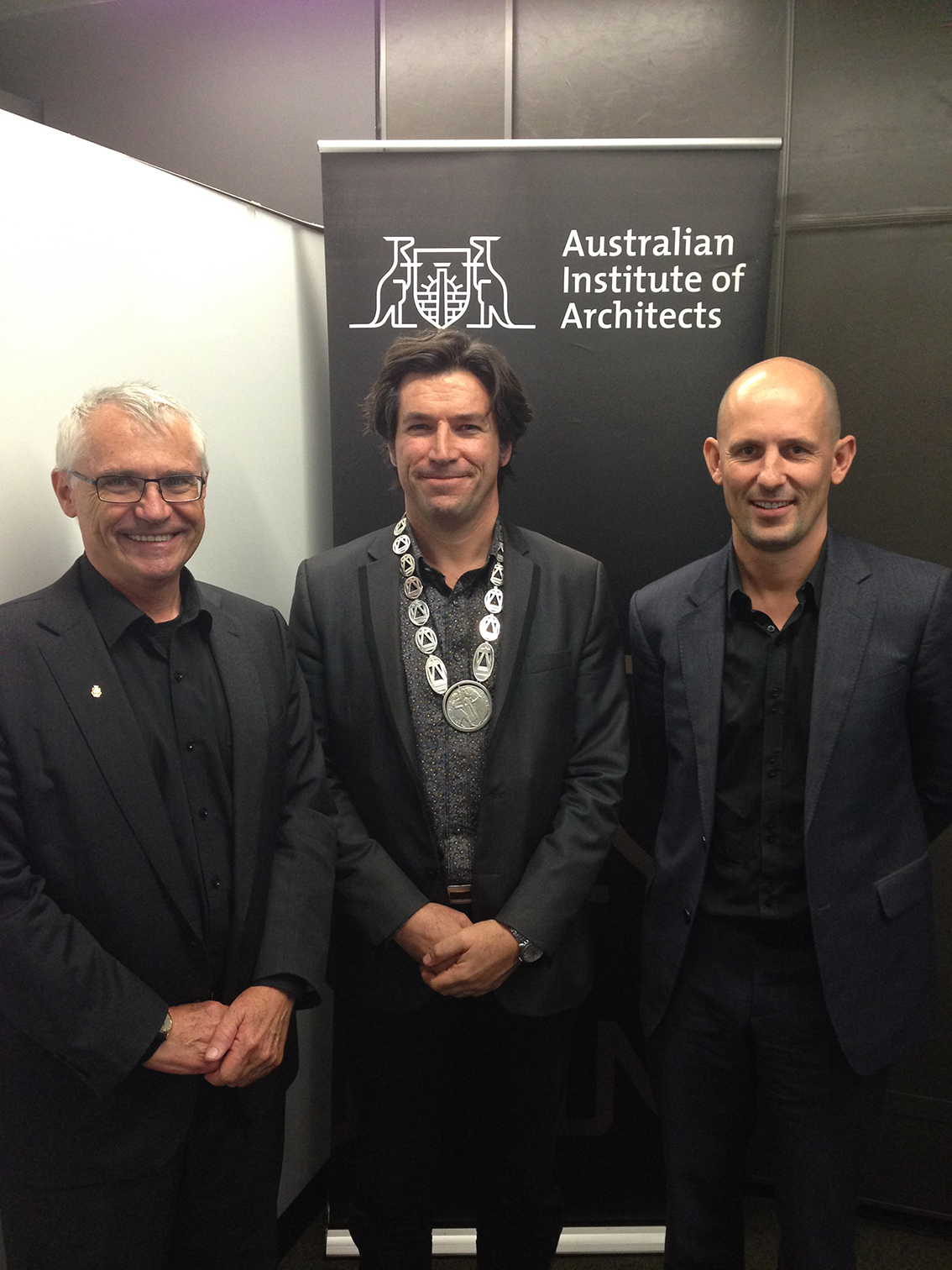
Immediate Past President Paul Berkemeier, National President David Karotkin and President Elect Jon Clements at the Annual General Meeting.

Mr Karotkin comes to the National Presidency following three years as WA Chapter President. In this role, he strongly advocated for the profession in that state. Now, the profession will benefit from his passion, leadership and advocacy at a national level.

‘I am honoured by the responsibility of representing our membership in this role and am dedicated to making a meaningful contribution throughout the year.

‘The role of National President is part of a continuum, from a term as National Councillor and President Elect through to support as Immediate Past President. And while I’ll continue to work with my fellow councillors in implementing strategic initiatives currently in development, I would also like to promote some issues that I am particularly interested in, including mandatory use of architects for the design of certain types of buildings and improved member engagement with the Institute,’ Mr Karotkin said.

Mr Karotkin received a Bachelor of Architecture, First Class Honours from Curtin University and is Managing Director of award winning Perth-based architectural consultancy Sandover Pinder, where he has worked since 1995. He has practised in the United Kingdom, Israel, Asia and Australia across a diverse portfolio of architectural projects including healthcare, education, law and order and community developments. Recently he led the firm’s expansion into the Indonesian healthcare industry, which has helped to set new international standards.

Taking over the role from Paul Berkemeier, Mr Karotkin thanked Mr Berkemeier for his leadership and contribution to issues including gender equity and diversity, and architectural education over the past 12 months.

‘Paul has been hugely valuable as a mentor and an advocate for the profession and his work in developing Australia’s bid for the UIA 2020 Congress is to be commended,’ Mr Karotkin said.

Former Victorian Chapter President Jon Clements has been appointed President Elect.

A name to honour

Nominations sought for new National Named Award

Our prestigious Named Awards are attributed to exceptional individuals, no longer living, who have made an outstanding contribution to architecture and are held in high regard by the profession.

We are seeking nominations for a new category: the National Named Award for Residential Architecture – Houses (Alts & Adds).

Recently, National Council resolved to divide the Housing category into two categories – New and Alts & Adds. The New Houses category will retain the name The Robin Boyd Award for Residential Architecture – Houses (New).

If there is someone you believe made a great contribution to Australian residential architecture during their lifetime (through their work in Alts & Adds, for example), please let us know. The nominee might not be an architect, but they must have a strong connection with the theme of this award*.

The entrant with the best nomination will win a ticket to the 2014 Awards event of their choice**

Please email the following to awards@architecture.com.au on or before 5pm AEST, 12 May.

-50-100 words on why you think this person is the best candidate

-a short biography of your nominee (optional)

-your name and contact details.

* Please note your nominee cannot be any of the names already honoured in our Awards program. Reference this attached listing to see those who are currently being honoured through the named awards.

** Chapter Awards event or National Awards event, excluding travel.


The architecture of 41X

By Josh McAlister

41X, the new home of the Australian Institute of Architects’ Melbourne-based teams, is a thin 21 level commercial office tower. The site is the Institute’s former residence on the corner of Flinders Lane and Exhibition Street. The journey to realisation for this project began in 2008 when the Institute conducted an Expression of Interest for a national design competition, which shortlisted four architectural practices, Ashton Raggatt McDougall, Design Inc., John Wardle Architects and Lyons Architects. The following commentary is gathered from an interview with the successful architects, Lyons, and discussions with co-directors of the project, Adrian Stanic and Carey Lyon.

The winning competition scheme was awarded in February 2009 with the Lyons entry judged as successful on overall design, sustainability, response to the city, commercial viability and the proposed image of the Institute capturing its past, present and future.  Stanic and Lyon suggest that the design intent of the competition design was maintained in the final building form.  As part of the competition entry, the four shortlisted entrants were commissioned to produce concept design drawings. Although the design was subject to significant detail resolution, the competition scheme bears considerable resemblance to what has been built.

The expression of the civic imagery for the Institute is key to the design concept of a public building within a commercial office tower. Lyons explored the idea of a hybrid public and commercial building by contrasting the permanence and weight of heavy stone like materials with corporate transparency. The form of the tower was developed as if sculpted from a stone block, avoiding atypical commercial disposition.

Revealing the Institute’s home to the city as a public space was a key feature of the Lyons competition entry. The Institute is located on the lower levels of the tower and has been designed to maximise public engagement.  Lyons’ conceptual idea of drawing the city street up into the building was achieved by locating a publically accessible stair at the perimeter of the building. The form of this monumental stair space was literally carved into the Flinders lane frontage visually connecting the Institute to the public realm, this then continues as additional internal circulation for the organisation.

The concept created a bespoke design for the Institute; they occupy the first five levels with access to the roof level on level 21. From the outset the Melbourne City Council (MCC) was supportive of having the Institute re-established in such a prominent city location. Although the site is located within a MCC height restriction zone where setbacks are required, Lyons argued no set back, instead proposing a reverse podium, cutting back the lower levels to widen the street. The effect of this strategy is the creation of a series of unique micro public spaces. The Institute (as developer) and the MCC saw this as an opportunity to give public space back to the streetscape, generally, something a commercial developer would not be inclined to do.

The original competition entry was for a 16 level building, being increased to 21 as the project evolved. The increase of five levels helped to make the project commercially viable. The site area is only 328m2 with the net sellable area being 275m2 per floor. To achieve efficiency on such a small floor plate the building core was continuously reworked to remove wasted space. Lyons examined the core in forensic detail with every 50 mm saving having a direct dollar value. One of the concessions made by the Melbourne City Council, that provided relief to the NLA, was a series of the bay windows that extend over the title boundary to the south facade. The bay windows allow views up and down Flinders Lane on all of the commercial levels, becoming the only building in the city to do so.

Lyons noted that the Institute was closely involved in the design process through project resulting in a significant partnership between the client, the architect and the contractor. The project was procured through a design and construct process with Lyons being novated to the successful bid team, Hickory Group.  Concerns regarding the loss of design intent were alleviated by achieving significant resolution of the design prior to novation. Lyons worked with the Institute to develop a tender package that was complete to Design Development level. As the developer, the Institute was able to insist that Lyons, as the designers, complete the documentation and construction phases  of the project.

The design and construct methodology enabled the Institute to de-risk the development process, as the delivery risk was passed directly to the contractor. Under this arrangement the Lyons and the design team worked directly with the contractor and sub-contractors to develop the various systems and related details, focusing on build-ability and quality to provide a positive outcome consistent with the design intent. On some occasions this process yielded results that exceeded the design intent, such as the original proposed concrete patterning on the north elevation, which was replaced with a high quality form liner solution for no additional cost.

The challenging feature ‘chiselled’ areas of the façade, were resolved through multiple workshops with the contractor and sub-contractors to ensure build-ability and quality. The contractor’s influence through the design and construct process was most evident in the alterations made to the design of concrete elements of the tower. Hickory Group initiated specific changes to the extent of precast to the exterior sun-shading fins and also the substitution of traditional concrete slab and band beam structure for an integrated BubbleDeck concrete floor system. This reduced the overall weight of the structure, reducing its material usage and increasing the structural efficiency of the building.

Now completed the occupancy of 41X is varied and diverse. These strata titled ownership arrangements are unique in the market offering single tenancy floors with three sided views of the city, making it one of Melbourne’s newest iconic boutique buildings. Overall this has proven to be a highly successful strategy for the Australian Institute of Architects.


David Adjaye confirmed for Making 2014

davidadjaye_team_portrait-1

David Adjaye OBE, Principal Architect of Adjaye Associates, is one of the leading architects of his generation. Described as an architect with an artist’s sensibility, his ingenious use of materials and showcasing of light have defined his work since establishing his practice in 2000. He was born in Tanzania in 1966 and lived in a number of different cities across the continent of Africa until settling in London at the age of thirteen. After gaining a B Arch from London South Bank University, he graduated with a Master’s degree in Architecture from the Royal College of Art in 1993, where he won the RIBA Bronze Medal.

Projects have been diverse in scale, audience, and geography. They include numerous private houses, exhibitions and pavilions as well as major arts centres and important public buildings across Europe, North America, the Middle East, Asia and Africa. These demonstrate his considered approach to understanding the needs of the constituency served by each building and a respect for their integration – culturally and architecturally – within the existing locale. Completed civic works include two neighbourhood libraries in Washington DC, Moscow School of Management SKOLKOVO, The Bernie Grant Arts Centre in London, the Museum of Contemporary Art in Denver and Rivington Place – a visual arts centre in London. His largest commission is the project to design the Smithsonian Institution’s National Museum for African American History and Culture on the National Mall in Washington DC, which is under construction.

David Adjaye’s belief in working together with artists and other cultural thinkers has led to a number of notable collaborations on both building projects as well as exhibitions, which include the Richard Avedon exhibition at New York’s Gagosian Gallery in 2012, Olafur Eliasson’s ‘Your Black Horizon’ light installation at the 51 st Venice Biennale in 2005 and Chris Offili’s ‘The Upper Room’, which is now in the permanent collection of Tate Britain. In addition, his practice invests considerably in critical research projects, including most recently, ‘Urban Africa: David Adjaye’s Photographic Survey’ – a unique geo-cultural catalogue profiling the African city in a global context.

His commitment to education extends to lecturing internationally; he was the first Louis Khan visiting professor at the University of Pennsylvania and was the Kenzo Tange Professor in Architecture at Harvard’s Graduate School of Design. Previously a unit tutor at the Architectural Association, David was also a lecturer at the Royal College of Art and he held a Visiting Professor post at Princeton University School of Architecture.

David was awarded the OBE for services to architecture in 2007 and received the Design Miami/ Year of the Artist title in 2011. In 2012 he reached number one on the Guardian’s ‘Powerlist’ of Britain’s most influential black people.

David is just one of the many impressive speakers taking part in Making 2014. For detailed program information, visit the conference website.